
CURIOSITY STARTS HERE
What is a stingray?
Stingrays are fish related to sharks. Their skeletons are made of cartilage, and their broad bodies and expanded pectoral fins give them their distinctive shape in the water. Watch a ray move and those fins are the first thing you notice.
For bottom-dwelling rays, the eyes and breathing openings called spiracles sit on top, while the mouth and gill openings are underneath. That arrangement helps them breathe while resting on the seabed.
Learn more: Florida Museum's guide to rays and southern stingray anatomy.
A calmer side to an often-misunderstood animal.
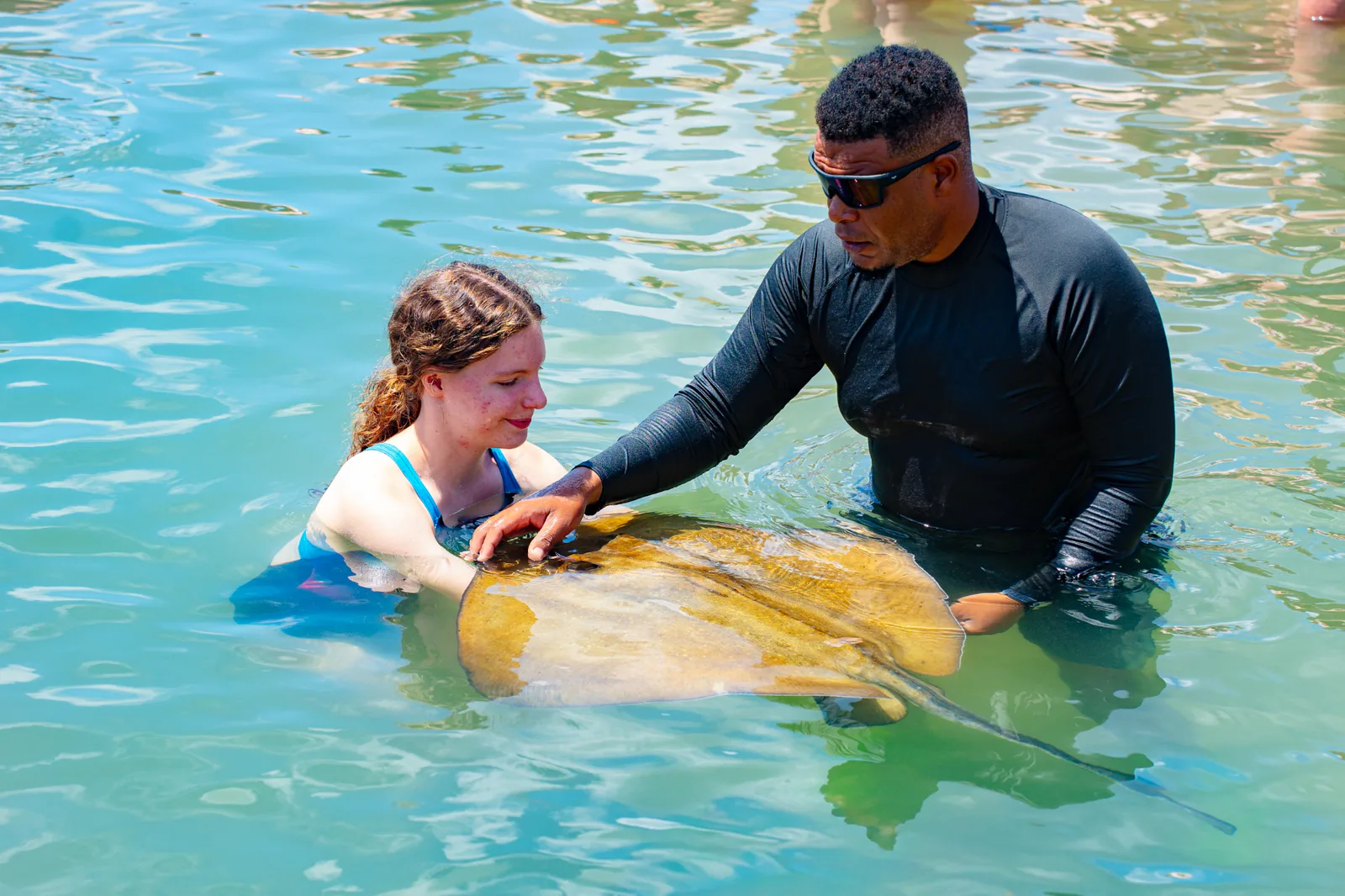
In a guided encounter, stingrays can be calm and approachable. Watching a ray glide, turn and feed reveals a friendly side that many visitors may not expect. Take time to notice the small details, with your guide helping you understand the animal in front of you and appreciate what makes each ray distinctive.
Behavior reference: Georgia Aquarium's southern stingray guide.
A tail and a barb are different things.
The tail is part of the ray's body. The barb, also called a defensive spine, is a separate structure on the tail. It can deliver venom and cause injury when used in defense. Understanding that distinction helps explain both how rays protect themselves and why a missing spine is different from a tail injury.
Many stingrays replace their spines. Studies of round stingrays describe this replacement, including after spine damage or loss. Spine replacement should not be confused with regrowth of a missing tail.
Source: California State University Long Beach Shark Lab: stingray biology and spine research.
THE STORIES THEY CARRY
Different histories. Individual personalities.
As you get to know the rays, you may notice that each has its own appearance. For some, the differences include visible signs of life before the lagoon: a shortened tail or an old injury from an encounter with fishing activity. Some arrived with a missing defensive spine, while others had lost part or a more substantial portion of their tail.
Fishing is an important part of Caribbean life and local livelihoods. A ray caught on a line or hook may be difficult to handle, and concern about injury can lead a fisher to remove the defensive spine or part of the tail. It is a story that calls for understanding of both the animals and the people who work on the water.
At Carambola, the next chapter unfolds in the everyday work of feeding, observation and care. The team watches the rays move and feed, keeps track of their general condition and maintains the lagoon. Guests become part of that story by taking the time to watch, ask questions and meet the animals with respect. An encounter that begins with curiosity can end with a lasting affection for creatures that are so often misunderstood.
THE TEAM BEHIND THE ENCOUNTER
Care, every day.
Stingray Lagoon is a guided visitor experience in a sheltered, enclosed saltwater lagoon at Carambola Beach Club in St. Kitts. A dedicated team cares for the rays and their environment each day.
Feeding
The team feeds the rays and provides the food used during guided guest encounters.
Observation
Regular observation helps the team keep track of the rays' behavior and general condition.
Their environment
Maintaining the lagoon is part of the team's ongoing daily care.
Ask the team what they have noticed that day. A change of direction, the movement of a fin or the way a ray searches for food can be a starting point for a memorable conversation.
MEET. OBSERVE. UNDERSTAND.
What will you learn during the encounter?
During your one-hour encounter, meet and feed the stingrays with guidance from the team. Watch how they move, ask about their anatomy and get to know their individual stories. After meeting the rays, choose optional snorkeling or nurse shark observation; the nurse sharks are in a separate area. A guided photo moment holding a stingray offers a memorable souvenir of your visit, with professional photographs available at an additional cost.
A little space. A lot to discover.
- Listen to the team before approaching or feeding a ray.
- Use only the food provided, and follow the guide's feeding directions.
- Give the animals room to move. Do not chase rays or pull their tails.
- Touch or hold a ray only with the team’s guidance, including during the photo moment. Do not handle the animals independently.
- If you feel unsure, say so before taking part. Ask about the requirements for each part of the activity.
You may arrive with questions—or a few nerves. Our invitation is to look closer, learn something new and leave with a deeper appreciation of stingrays.
Explore the guided stingray encounter, price and inclusionsA DIFFERENT PERSPECTIVE
A connection that stays with you.
Our purpose is to help every guest leave with a deeper understanding of stingrays and an appreciation of their calm, approachable nature. Through guided encounters, we hope to replace common misconceptions with personal experience: time spent watching, learning and discovering how friendly these remarkable animals can be.
We invite you to notice the details that give each ray its own character—the way it moves, approaches food and responds to its surroundings. By sharing their stories and helping you connect with them, we aim to leave you with a sense of the rays' individual personalities, a lasting affection for them and a new perspective to carry home.
QUESTIONS WORTH ASKING
Stingray facts & lagoon FAQs
Are stingrays friendly?
Stingrays can be calm, curious and surprisingly approachable. During the encounter, the team helps you notice their different movements and personalities while guiding every interaction. Give them space to move naturally and follow the team’s directions so you can enjoy getting to know them at a comfortable pace.
What time does the stingray encounter depart?
Stingray departures are at 10:00 AM, 12:00 PM and 2:00 PM, St. Kitts local time. The encounter lasts one hour. Direct guests should arrive at Carambola Beach Club at least 15 minutes before their confirmed start time. Port Zante pickups are 35 minutes before the lagoon session: 9:25 AM for 10:00 AM, 11:25 AM for 12:00 PM, and 1:25 PM for 2:00 PM. All times are St. Kitts local time.
What do stingrays eat?
Many stingrays forage on the seabed for animals such as shellfish, worms, crustaceans and small fish. Diet varies by species. During the encounter, use only the food provided by the team.
Can a stingray's barb grow back?
Many stingrays replace their defensive spines. Research on round stingrays documents replacement of lost or damaged spines. This is a different process from healing an injury to the tail itself; it does not establish that a missing tail will regrow.
Why are some rays missing part of their tails?
Some rays arrived at Stingray Lagoon with previous injuries associated with fishing activity. These may involve the defensive spine, part of the tail or a larger portion of the tail. Their histories are part of the lagoon's daily-care story.
Can I swim with stingrays at Carambola Beach Club?
The Stingray Lagoon experience includes meeting and feeding stingrays, with optional snorkeling. The encounter itself requires no swimming skills; confirm separate snorkeling requirements with the team before taking part.
Where is Stingray Lagoon?
Stingray Lagoon is at Carambola Beach Club in St. Kitts. Direct guests are greeted at the beach club and directed to the lagoon a few steps away. Shore-excursion guests meet their designated taxi driver at the St. Kitts Statue at Port Zante in Basseterre; both shore excursions include a Timothy Hill stop and return to Port Zante.
Can I visit Stingray Lagoon if I’m travelling on a cruise?
Yes. Both shore excursions include pickup at the St. Kitts Statue at Port Zante in Basseterre, a quick photo stop at Timothy Hill and the one-hour activity at Carambola. Choose US$124 to return to Port Zante after the activity, or US$145 to add two hours of beach time and a beach bed. View the shore-excursion options and itineraries and check the timing against your ship’s schedule. Choose your package and date in its booking calendar.
Where do cruise guests meet, and are transfers included?
Yes. Both shore excursions include pickup and drop-off at Port Zante. Meet your designated taxi driver at the St. Kitts Statue at Port Zante in Basseterre, then follow the driver to the vehicle. Port Zante pickups are 35 minutes before the lagoon session: 9:25 AM for 10:00 AM, 11:25 AM for 12:00 PM, and 1:25 PM for 2:00 PM. All times are St. Kitts local time. View the shore-excursion itineraries or contact the team with your ship’s name and arrival date.
How much time should I allow during my cruise stop?
The activity at Carambola lasts one hour. The beach-break option adds two hours of beach time, making three hours at Carambola. For both shore excursions, allow additional time for transfers and the Timothy Hill photo stop. Compare the shore-excursion itineraries and plan around your ship’s all-aboard time.
Biology references: Florida Museum, Georgia Aquarium and CSULB Shark Lab. Lagoon history and daily-care information were supplied by Stingray Lagoon. Updated 3 October 2026.